Kindred Found Hit the Gas and Leave the Wreckage Behind on “Devil’s on the Highway”
- Editorial Board

- Jun 3
- 3 min read
“Devil’s on the Highway” sounds like a frenetic escape through the desert with the past still visible in the rearview mirror.

Kindred Found turn heartbreak into a full-speed country-western chase on “Devil’s on the Highway.” The song does not sit quietly with the damage of a relationship ending. It throws the listener into the passenger seat and drives straight through it.
From the opening lyric, the devil is not presented as something to fear. He becomes the narrator’s getaway driver:
“The devil’s on the highway, he’s driving real fastHope he’s going my way, gotta run from the past”
That image gives the track its core tension. The narrator knows the road ahead could be dangerous, but staying behind feels worse. He is not searching for healing yet. He is searching for distance. The repetition of “gone, gone, gone” turns the chorus into something urgent and instinctive, almost like the words are being shouted over the engine.
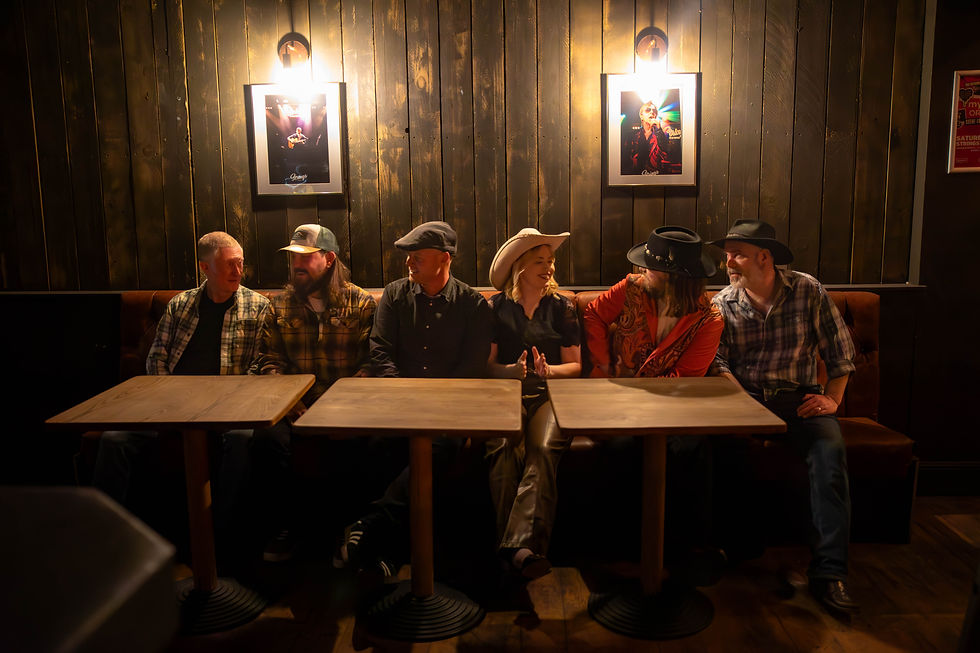
The production captures that momentum perfectly. Jerry Bart’s drums push the track forward at a relentless pace, giving it the restless energy of an old Western saloon band playing with a rock and roll engine underneath it. Mick Couch’s double bass reinforces the roots-driven feel, while Dan Smith’s acoustic and electric guitars keep the arrangement sharp and moving.
The standout instrumental voice comes from Simon Clark’s harmonica. Rather than simply filling space between vocal lines, the harmonica acts like a second character in the story. It answers Dave Eastman’s lead vocals with quick countermelodies, creating a call-and-response effect that feels a talk between two friends.
Eastman delivers the confession, and the harmonica responds like the road itself, dusty, chaotic, and strangely inviting.
The sound is made for a long drive through an empty stretch of desert. Windows down. Heat still rising from the pavement. Nothing visible except the highway ahead.
Lyrically, the track gradually reveals that the escape is not only physical. The narrator has been permanently changed by the relationship he is trying to outrun:
“There’s nothing left for me in my hometown but painYou surely saw to that the day you walked away”
The bitterness becomes more direct as the verse continues. There is no attempt to sanitize the resentment or dress it up in poetic ambiguity. When Eastman sings, “Your face is golden, bitch, but your heart’s fucking black,” the song reaches its rawest point. It is harsh, but intentionally so. The narrator is no longer trying to sound reasonable. He is speaking from the moment where heartbreak becomes anger.
The second verse expands the story beyond his own pain. He imagines the same cycle repeating with someone else:
“You don’t know how to deal in nothing but heartbreakThat’s why you leave a trail of bodies in your wake”
By the final section, the track takes a darker turn. The narrator admits that the relationship did not simply hurt him. It reshaped him:
“You broke my heart in two and set my darkness freeI never wanted to but now I’ve crossed that line”
The final confession is what gives the song weight. He has become part of the same destructive cycle he originally blamed on someone else. The highway is no longer only an escape route. It is the point of no return.
Backing vocals from Dan Smith and Rosie Sales add lift to the arrangement, while Shaun Sales’ hand claps reinforce the ragtime spirit underneath the country-rock energy. Every part feels intentional. The song is fast, catchy, and easy to enjoy on the surface, but the lyrics leave a darker trail behind it.
With “Devil’s on the Highway,” Kindred Found deliver a country-rock track that feels reckless in the right way. It is bitter, cinematic, and built for motion. The harmonica keeps calling. The drums keep chasing. The narrator keeps driving.
Follow Kindred Found on Instagram . And listen to “Devil’s on the Highway” on all streaming platforms .